> For the complete documentation index, see [llms.txt](https://docs.terrakube.io/llms.txt). Markdown versions of documentation pages are available by appending `.md` to page URLs; this page is available as [Markdown](https://docs.terrakube.io/user-guide/workspaces/provider-cache.md).
# Provider Cache
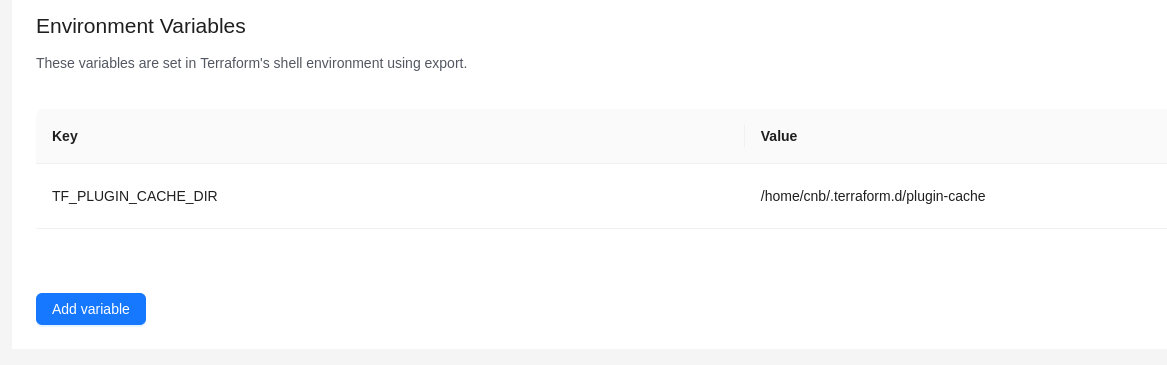
The component use to execute terraform/opentofu configuration is stateless so everytime that it is executing a job will try to download the terraform/opentofu providers, in order to speed up the execution the following environment variable can be added to have a provider cache.
```
TF_PLUGIN_CACHE_DIR=/home/cnb/.terraform.d/plugin-cache
```
When deploying the helm chart the following can be used to add an emptyDir volume to cache the providers.
```
executor:
volumes:
- name: cache-volume
emptyDir:
sizeLimit: 1024Mi
volumeMounts:
- mountPath: /home/cnb/.terraform.d/plugin-cache
name: cache-volume
```
When running tofu init, temporary files such as .terraform.lock.hcl are generated based on the current machine’s architecture. On subsequent runs, OpenTofu verifies that the required providers match the architecture specified in the lock file to decide whether a new download is necessary.
However, when working locally on macOS, the architecture (e.g., darwin/amd64 or darwin/arm64) differs from the architecture used by remote Terrakube jobs (linux/arm64). This mismatch forces OpenTofu to redownload providers each time.
If you want to avoid that issue you need to run this command to generate lock file for Terrakube's image architecture.
```
tofu providers lock -platform=linux_amd64
```
{% hint style="warning" %}
Make sure to use the correct size for the volume mount, in the example is only using 1024Mi, more information can be found in this [link](https://developer.hashicorp.com/terraform/cli/config/config-file#provider-plugin-cache)
{% endhint %}
{% hint style="warning" %}
If you want to use cache with EphemeralJob you will need to provision a volume with in ReadWriteMany as several jobs can be writing to the cache at the same time.
{% endhint %}
---
# Agent Instructions
This documentation is published with GitBook. GitBook is the documentation platform designed so that both humans and AI agents can read, navigate, and reason over technical content effectively. Learn more at gitbook.com.
## Querying This Documentation
If you need additional information that is not directly available in this page, you can query the documentation by asking a question.
Perform an HTTP GET request on the following URL with the `ask` and `goal` query parameters:
```
GET https://docs.terrakube.io/user-guide/workspaces/provider-cache.md?ask=&goal=
```
`ask` is the immediate question: it should be specific, self-contained, and written in natural language.
`goal` is what the user is ultimately trying to achieve, the reason they need the answer. Sharing it helps GitBook give you a better, more relevant answer. A goal is most helpful when it describes the outcome the user wants rather than restating the question. For example, with `ask=how do I create an API token`, a goal like `automate deployments from our CI pipeline` lets GitBook tailor the answer to that use case.
The response will contain a direct answer to the question and relevant excerpts and sources from the documentation.
Use this mechanism when the answer is not explicitly present in the current page, you need clarification or additional context, or you want to retrieve related documentation sections.