> For the complete documentation index, see [llms.txt](https://docs.terrakube.io/llms.txt). Markdown versions of documentation pages are available by appending `.md` to page URLs; this page is available as [Markdown](https://docs.terrakube.io/2.22.0/getting-started/user-management/azure-active-directory.md).
# Azure Active Directory
{% hint style="warning" %}
Azure Authentication with Dex Connecor require Terrakube >= 2.6.0 and Helm Chart >= 2.0.0
{% endhint %}
### Requirements
* Azure Active Directory [here](https://developer.microsoft.com/en-us/microsoft-365/dev-program)
* Azure Storage Account
For this example lets image that you will be using the following domains to deploy Terrakube.
* registry.terrakube.azure.com
* ui.terrakube.azure.com
* api.terrakube.azure.com
### Setup Azure Authentication
You need to complete the Azure authentication setup for Dex. You can found information in this [link](https://dexidp.io/docs/connectors/microsoft/)
You need to go to your Azure and create a new Application
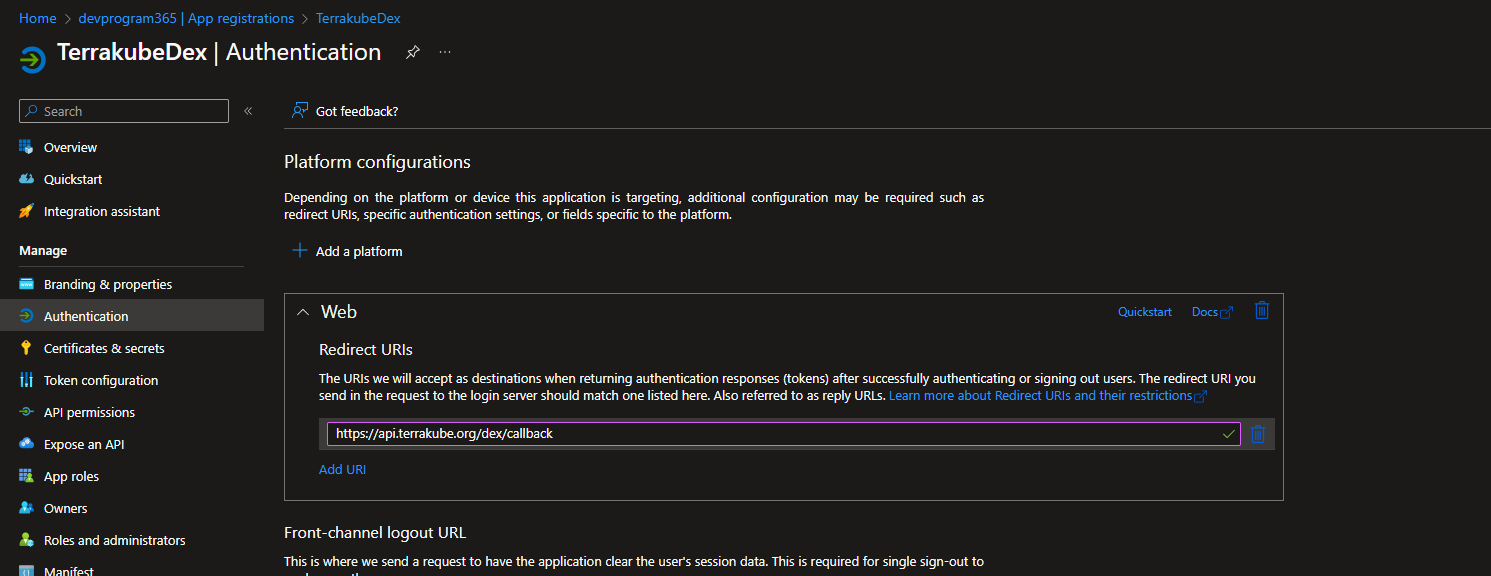
After the application is created you need to add the redirect URL.
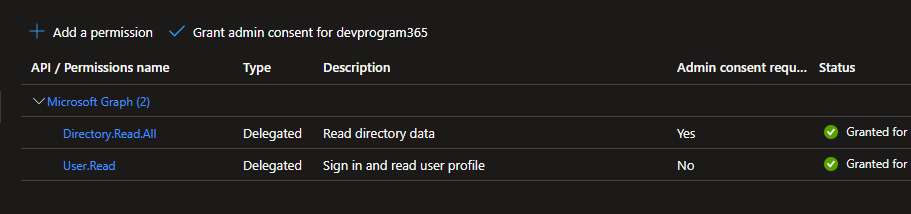
You will also need to add the permission Directory.Read.All and ask a Azure administrator to approve the permission.
Now you can create the DEX configuration, you will use this config later when deploying the helm chart.
```
## Dex
dex:
config:
issuer: https://api.terrakube.azure.com/dex
storage:
type: memory
oauth2:
responseTypes: ["code", "token", "id_token"]
skipApprovalScreen: true
web:
allowedOrigins: ['*']
staticClients:
- id: microsoft
redirectURIs:
- 'https://ui.terrakube.azure.com'
- 'http://localhost:10001/login'
- 'http://localhost:10000/login'
- '/device/callback'
name: 'microsoft'
public: true
connectors:
- type: microsoft
id: microsoft
name: microsoft
config:
clientID: "<>"
clientSecret: "<>"
redirectURI: "https://api.terrakube.azure.com/dex/callback"
tenant: "<>"
```
The firt step is to clone the repository.
```
git clone https://github.com/AzBuilder/terrakube-helm-chart.git
```
Replace *<\>* with the real values, create the values.yaml file and run the helm install
```
## Global Name
name: "terrakube"
## Terrakube Security
security:
adminGroup: "<>" # The value should be a valida azure ad group (example: TERRAKUBE_ADMIN)
patSecret: "<>" # Sample Key 32 characters z6QHX!y@Nep2QDT!53vgH43^PjRXyC3X
internalSecret: "<>" # Sample Key 32 characters Kb^8cMerPNZV6hS!9!kcD*KuUPUBa^B3
dexClientId: "microsoft"
dexClientScope: "email openid profile offline_access groups"
## Terraform Storage
storage:
azure:
storageAccountName: "XXXXXXX" # <>
storageAccountResourceGroup: "XXXXXXX" # <>
storageAccountAccessKey: "XXXXXXX" # <>
## Dex
dex:
config:
issuer: https://api.terrakube.azure.com/dex
storage:
type: memory
oauth2:
responseTypes: ["code", "token", "id_token"]
skipApprovalScreen: true
web:
allowedOrigins: ['*']
staticClients:
- id: microsoft
redirectURIs:
- 'https://ui.terrakube.azure.com'
- 'http://localhost:10001/login'
- 'http://localhost:10000/login'
- '/device/callback'
name: 'microsoft'
public: true
connectors:
- type: microsoft
id: microsoft
name: microsoft
config:
clientID: "<>"
clientSecret: "<>"
redirectURI: "https://api.terrakube.azure.com/dex/callback"
tenant: "<>"
## API properties
api:
enabled: true
replicaCount: "1"
serviceType: "ClusterIP"
properties:
databaseType: "H2"
## Executor properties
executor:
enabled: true
replicaCount: "1"
serviceType: "ClusterIP"
properties:
toolsRepository: "https://github.com/AzBuilder/terrakube-extensions"
toolsBranch: "main"
## Registry properties
registry:
enabled: true
replicaCount: "1"
serviceType: "ClusterIP"
## UI Properties
ui:
enabled: true
replicaCount: "1"
serviceType: "ClusterIP"
## Ingress properties
ingress:
useTls: true
ui:
enabled: true
domain: "ui.terrakube.azure.com"
path: "/(.*)"
pathType: "Prefix"
annotations:
kubernetes.io/ingress.class: nginx
nginx.ingress.kubernetes.io/use-regex: "true"
cert-manager.io/cluster-issuer: letsencrypt
api:
enabled: true
domain: "api.terrakube.azure.com"
path: "/(.*)"
pathType: "Prefix"
annotations:
kubernetes.io/ingress.class: nginx
nginx.ingress.kubernetes.io/use-regex: "true"
nginx.ingress.kubernetes.io/configuration-snippet: "proxy_set_header Authorization $http_authorization;"
cert-manager.io/cluster-issuer: letsencrypt
registry:
enabled: true
domain: "registry.terrakube.azure.com"
path: "/(.*)"
pathType: "Prefix"
annotations:
kubernetes.io/ingress.class: nginx
nginx.ingress.kubernetes.io/use-regex: "true"
nginx.ingress.kubernetes.io/configuration-snippet: "proxy_set_header Authorization $http_authorization;"
cert-manager.io/cluster-issuer: letsencrypt
dex:
enabled: true
path: "/dex/(.*)"
pathType: "Prefix"
annotations:
kubernetes.io/ingress.class: nginx
nginx.ingress.kubernetes.io/use-regex: "true"
nginx.ingress.kubernetes.io/configuration-snippet: "proxy_set_header Authorization $http_authorization;"
cert-manager.io/cluster-issuer: letsencrypt
```
Run the installation
```bash
helm install --debug --values ./values.yaml terrakube ./terrakube-helm-chart/ -n terrakube
```
{% hint style="warning" %}
For any question or feedback please open an issue in our [helm chart repository](https://github.com/AzBuilder/terrakube-helm-chart)
{% endhint %}
---
# Agent Instructions
This documentation is published with GitBook. GitBook is the documentation platform designed so that both humans and AI agents can read, navigate, and reason over technical content effectively. Learn more at gitbook.com.
## Querying This Documentation
If you need additional information that is not directly available in this page, you can query the documentation by asking a question.
Perform an HTTP GET request on the following URL with the `ask` and `goal` query parameters:
```
GET https://docs.terrakube.io/2.22.0/getting-started/user-management/azure-active-directory.md?ask=&goal=
```
`ask` is the immediate question: it should be specific, self-contained, and written in natural language.
`goal` is what the user is ultimately trying to achieve, the reason they need the answer. Sharing it helps GitBook give you a better, more relevant answer. A goal is most helpful when it describes the outcome the user wants rather than restating the question. For example, with `ask=how do I create an API token`, a goal like `automate deployments from our CI pipeline` lets GitBook tailor the answer to that use case.
The response will contain a direct answer to the question and relevant excerpts and sources from the documentation.
Use this mechanism when the answer is not explicitly present in the current page, you need clarification or additional context, or you want to retrieve related documentation sections.