> For the complete documentation index, see [llms.txt](https://docs.terrakube.io/llms.txt). Markdown versions of documentation pages are available by appending `.md` to page URLs; this page is available as [Markdown](https://docs.terrakube.io/2.34.0/updates.md).
# Updates
### Coming in 2.35
{% hint style="info" %}
These are planned and not yet released. Scope can change; follow progress in the [2.35 milestone](https://github.com/terrakube-io/terrakube/milestone/34).
{% endhint %}
* **Registry:** better performance and caching, provider mirroring, and sharing.
* **Projects:** better navigation, access controls and shared configuration.
* **Cost estimation:** Infracost estimates in runs, pull requests and cost policies. See [Cost Estimation](/2.34.0/govern/cost-estimation.md) for what is possible today.
* **Single-domain deployment:** an optional setup serving the UI, API, registry and Dex from one domain.
### 2.34.0 (upcoming)
#### Policy Governance (OPA)
Platform teams can now enforce Open Policy Agent policies across every run. Policy sets are stored in Git, attached to an organization, project, tag or workspace, and evaluated inside the runner before apply at one of three levels (`hard_mandatory`, `soft_mandatory`, `advisory`). Soft violations can be overridden by a designated team with an audited justification, individual rules can be waived with expiring exemptions, and a nightly job surfaces compliance drift. See [Policy Governance](/2.34.0/govern/policy-enforcement-opa.md). The previous template-based approach is documented as [legacy](/2.34.0/govern/policy-enforcement-opa/policy-enforcement-opa-templates.md).
#### Run Triggers
Workspaces can be chained: when an apply changes the source workspace, a run is queued in each dependent workspace, with loop detection and a dependency view in the UI. See [Run Triggers](/2.34.0/run-terraform/workspaces/run-triggers.md).
#### Terraform and OpenTofu CLI login
`terraform login` and `tofu login` can authenticate through a Terrakube OAuth broker that issues a revocable personal access token with a lifetime you choose. See [CLI-driven Workflow](/2.34.0/run-terraform/workspaces/cli-driven-workflow.md#terraform-login).
#### Runs
* Run approval moved to a sticky bar on the run page and to the workspace overview, which now shows the run that needs action. Terrakube records who approved a run. See [Starting a Run](/2.34.0/run-terraform/workspaces/starting-a-run.md#approve-or-discard-a-run).
* Run-specific Terraform variables can be sent with a job from CI. See [API-driven Workflow](/2.34.0/run-terraform/workspaces/api-driven-workflow.md).
* Templates can require the saved plan at apply with `requireSavedPlan`. See [Templates](/2.34.0/set-up/organizations/templates.md#require-a-saved-plan).
* The Terrakube GitHub Action 2.0.0 supports Terrakube 2.34 with GitHub OIDC, exact-commit runs, per-run variables, and plan then apply with GitHub environment approval. See [GitHub Actions](/2.34.0/integrate/ci-cd-integration/github-actions.md).
* Files built by the plan step can be carried to the apply step. See [Plan Artifacts](/2.34.0/run-terraform/workspaces/plan-artifacts.md).
* Structured output and logs are more reliable and clearer; see the next section.
* Ephemeral executor jobs gained deadline, backoff, TTL and grace period controls. See [Ephemeral Agents](/2.34.0/getting-started/deployment/ephemeral-agents.md).
#### Structured output and logs
* **A Diagnostics panel** lists every error and warning for the run, unaffected by resource filters.
* **Output changes** are shown when a plan changes only root module outputs, instead of "no changes".
* **Final-result indicator:** each step says whether its result is final, being recovered, partial or lost, so a progress snapshot is never mistaken for a finished plan.
* **Durable results:** if the API is unavailable when a step ends, the final structured result is saved to storage and applied automatically when it returns. The run does not need repeating.
* **Logs survive an executor crash:** output is archived to storage in parts while a step runs, and the Console serves it, with a notice, if the executor dies.
* **Bounded memory:** live lines over 64 KiB are shortened in the live view only, step output spills to disk above 4 MiB, and the text published for pull request comments is capped (48 KiB by default) with a note; the full output is always kept.
* **Scales to many viewers:** live log streaming no longer degrades with many concurrent viewers or very large logs, and a slow viewer cannot hold up others.
* **Apply output no longer repeats the plan**, and remote CLI applies stream their logs correctly.
* **Executor logs:** step output is no longer copied to the executor's own log (`kubectl logs`) by default.
See [Job Output](/2.34.0/run-terraform/workspaces/job-output.md) and [Executor Log Output](/2.34.0/getting-started/deployment/executor-log-output.md).
#### Workspaces and projects
* Workspaces can have key/value tags, editable in the UI and filterable in the list. See [Tags](/2.34.0/set-up/organizations/tags.md).
* A workspace's repository URL and VCS provider can be changed in **Settings → General**. See [Creating Workspaces](/2.34.0/run-terraform/workspaces/creating-workspaces.md#changing-the-repository-or-vcs-provider).
* The webhook settings were redesigned with per-pattern validation, priority ordering and shared-webhook controls. See [Webhooks](/2.34.0/run-terraform/workspaces/webhooks.md).
* A Module Cache page documents sharing `TF_DATA_DIR` between runs. See [Module Cache](/2.34.0/run-terraform/workspaces/module-cache.md).
* Projects can be searched, workspace lists group by project, and the project workspaces tab shows each workspace's last run.
#### Registry
* Module and provider versions can be deprecated or removed. See [Deprecating and Removing Versions](/2.34.0/private-registry/private-registry/deprecating-and-removing-versions.md).
* Public providers open a provider page with the latest version preselected before you add them. See [Using Providers](/2.34.0/private-registry/private-registry/using-providers.md).
* Module inputs, outputs and resources are parsed on the server, which makes large modules open faster.
* The module refresh delay is configurable, and the registry can redirect module downloads to presigned S3, Azure Blob or Google Cloud Storage URLs. See [Private Registry](/2.34.0/private-registry/private-registry.md).
#### Storage and operations
* S3-compatible stores can set the signing region, path-style addressing, chunked encoding and checksum validation. See [Amazon Cloud Storage](/2.34.0/getting-started/deployment/storage-backend/amazon-cloud-storage.md).
* Dynamic credential tokens carry a `terrakube_project_name` claim, and federated credentials accept multi-audience OIDC tokens. See [Dynamic Provider Credentials](/2.34.0/run-terraform/workspaces/dynamic-provider-credentials.md).
* Live log viewing scales to many concurrent viewers, and large organizations load faster through aggregated summaries and cursor pagination.
* Spring Boot was upgraded to 4.1.
#### UI
The workspace, run, state, settings and registry pages were refreshed, with a dark theme and accessibility fixes, a responsive layout with a sidebar drawer on narrow screens, and faster initial load.
### August 2026 (2.33.0)
#### Notifications
Organizations and workspaces can now send Slack, Microsoft Teams, or generic webhook notifications when a job's status changes — configurable at either scope, additively. See [Notifications](/2.34.0/run-terraform/workspaces/notifications.md).
#### Target and Replace Resources in New Run
The native **New Run** dialog gained an **Additional planning options** section for Terraform's `-target`/`-replace` flags, autocompleted against the workspace's actual state resources. See [Starting a Run](/2.34.0/run-terraform/workspaces/starting-a-run.md).
#### Federated Identity (OIDC) and Variable Collections
Organizations can now trust an external OIDC issuer (e.g. GitHub Actions) to authenticate directly to the API, CLI, and module registry without a stored token — see [Federated Identity](/2.34.0/set-up/organizations/federated-identity.md). Variables can also be grouped into reusable, filterable [Variable Collections](/2.34.0/set-up/organizations/variable-collections.md) shared across workspaces.
#### Structured Job Output, Apply and Imports
The structured plan output view introduced in 2.31.0 now covers `apply` runs and resource imports as well, with real-time diff rendering and strict sensitive-attribute handling. See [Job Output](/2.34.0/run-terraform/workspaces/job-output.md).
#### Executor Reliability
Executor pools can now safely scale across multiple replicas. Distributed admission control keeps each pod to one job, the dispatcher schedules queued work FIFO and recovers stuck jobs automatically, and a `503` retry backstop handles brief readiness races. Terraform/OpenTofu binaries are cached in cloud storage rather than re-downloaded per job, and Terrakube falls back to the last-known release index if HashiCorp's/OpenTofu's index is briefly unreachable. See [Self-Hosted Agents](/2.34.0/getting-started/deployment/self-hosted-agents.md) and [Terraform Versions](/2.34.0/reference/executor/terraform-versions.md).
#### AWS Dynamic Credentials ABAC
AWS dynamic credentials can now emit session tags in their OIDC JWT. This enables IAM policies based on `aws:PrincipalTag`, so a single role can enforce attribute-based access control across workspaces. See [AWS Dynamic Provider Credentials](/2.34.0/run-terraform/workspaces/dynamic-provider-credentials/aws-dynamic-provider-credentials.md).
#### Registry and Modules
Module registry versions are now validated and published as canonical SemVer instead of raw git tags, and registered federated credentials now also authenticate registry/module-pull requests.
#### Other improvements
* Workspace and organization list pages were modernized with a condensed, filterable, groupable view (alongside the previous table view).
* Azure DevOps v1/v2 webhooks, GitLab shared repository-level webhooks, and repository auto-discovery make workspace VCS onboarding and webhook management more complete. See [Creating Workspaces](/2.34.0/run-terraform/workspaces/creating-workspaces.md) and [Azure DevOps](/2.34.0/set-up/vcs-providers/azure-devops.md).
* GitLab joined GitHub for shared-repository webhook consolidation, and approval steps gained an `onReject` command hook.
* An in-app API reference is now available from the **Help & Support** menu.
* Run status and logs now stream via SSE/GraphQL subscriptions instead of polling.
#### Supply-Chain Safeguards
Terrakube's build pipeline now runs OpenSSF Scorecard analysis, generates Syft software bills of materials (SBOMs) for container builds, and uses digest-pinned base images to make build inputs reproducible. These safeguards are built into the release process and require no runtime configuration. See [Security](/2.34.0/how-it-works/security.md).
### June 2026 (2.32.0)
#### Project Management UI
Projects — introduced in 2.28.0 as an organizational layer above workspaces — gained dedicated management pages in the UI, including project-level team permissions with inline role editing on the project access tab. See [Projects](/2.34.0/set-up/projects.md).
#### Terraform Version Constraints
The workspace **Terraform Version** field now accepts semantic version constraints (e.g. `>= 1.12.5`) in addition to an exact version, resolved at run time. See [Terraform Versions](/2.34.0/reference/executor/terraform-versions.md).
#### VCS Provider Client Editing
VCS provider settings gained an **Edit Client** option for updating OAuth/App client credentials without deleting and recreating the provider connection.
### April 2026 (2.31.0)
#### RBAC v2 Refinements and Structured Plan Output
Following 2.30.0's RBAC v2 rollout, this release introduced the first version of the structured plan output view (expanded further in 2.33.0) and an improved Terraform import experience in the UI.
#### Atlantis-Style PR Workflow
Webhook-triggered jobs gained an Atlantis-style pull request workflow — plan output posted as PR comments, with `terrakube plan`/`terrakube apply` PR comment commands to drive runs.
#### Federated Authentication
Initial federated authentication support landed, handling multiple trusted OIDC issuers, later extended with claim-condition scoping (repository, branch, environment, etc.) and documented in full as [Federated Identity](/2.34.0/set-up/organizations/federated-identity.md) in 2.33.0.
#### Shared Repository Webhooks v3 and Remote State
Shared repository-level VCS webhooks were reworked (v3), and workspaces gained support for global and shared remote state configuration. Executor-to-API communication also moved to JWT-based authentication.
### February 2026 (2.30.0)
#### RBAC v2 and Frontend Redesign
This release shipped RBAC v2 — granular, TFC-style permissions across the organization/project/workspace hierarchy — alongside a broader frontend redesign adopting an HCP Terraform-style UI and performance optimizations. See [Team Management](/2.34.0/set-up/organizations/team-management.md).
#### onFailure Hooks and Job History Retention
Templates gained `onFailure` scripts that run when a Terraform operation fails, and job history retention became configurable per workspace via a `KEEP_JOB_HISTORY` variable.
#### UI Improvements
A new terminal-style job log viewer (with toolbar), sortable workspace and variable listings, sensitive-output copy support, and a modal for editing Variable Collection entries.
### December 2025 (2.29.0)
#### Module and Provider Performance
Module and provider services were refactored onto GraphQL with caching, meaningfully speeding up module/version lookups, alongside job deletion support and importing templates from a private repository.
#### Job and Workspace UI
The job run view now shows workspace and VCS details inline, variable tables gained sortable columns, and dark mode received a round of polish.
### October 2025 (2.28.0)
#### Projects
Terrakube introduced **Projects**, a grouping layer between organizations and workspaces for organizing workspaces by team or environment. See [Projects](/2.34.0/set-up/projects.md).
#### Dynamic Credentials and Storage
Dynamic provider credentials gained a configurable hostname override for non-default cloud endpoints, and Cloudflare R2 joined the supported object storage backends alongside AWS, Azure, and GCP.
#### Ephemeral Executor Environment Variables
The `EPHEMERAL_JOB_ENV_VARS` variable was added to pass additional environment variables into ephemeral executor jobs, and bash-script steps gained the ability to persist environment variables for later steps.
### July 2025 (2.27.0)
This release introduces several significant advancements designed to enhance the functionality, security, and integration capabilities of Terrakube.
#### New UI container
The `terrakube-ui` container now utilizes the `nginxinc/nginx-unprivileged` image, replacing the `bitnami/nginx` image used in previous versions.
#### Centralized Terraform Module Version Management
Terraform module versions are now persistently managed within the database, transitioning from the prior Redis-based ephemeral storage. Upon the initial startup following this update, Terrakube will initiate a comprehensive update of all modules. This process may require several minutes, depending on the volume of existing modules.
#### Dynamic Credential Authentication
Enhanced support has been implemented for dynamic credential authentication with Openbao or Vault, streamlining secure access and integration with these systems.
Inside the workspace settings it only requires to use the following variables
When running a job for example using the terraform cloud block it will work like the following:
```
terraform plan
Preparing the remote plan...
To view this run in a browser, visit:
https://terrakube-api.platform.local/app/simple/vault/runs/run-1
Waiting for the plan to start...
***************************************
Running Terraform PLAN
***************************************
data.vault_kv_secret_v2.password: Reading...
data.vault_kv_secret_v2.password: Read complete after 0s [id=shared/data/kv/creds]
No changes. Your infrastructure matches the configuration.
```
#### GitLab Integration
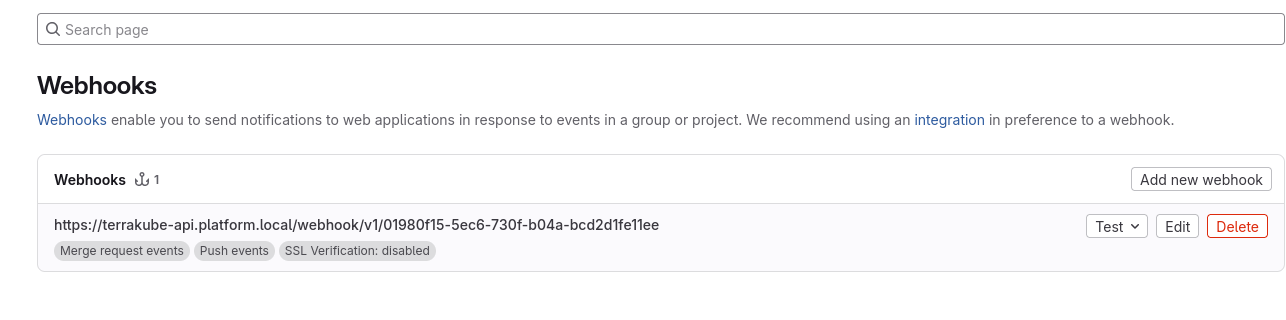
Jobs can now be automatically triggered by `merge request` and `release` events within GitLab repositories when defining the webhook configuration like the following:
A gitlab webhook will be created inside the repository
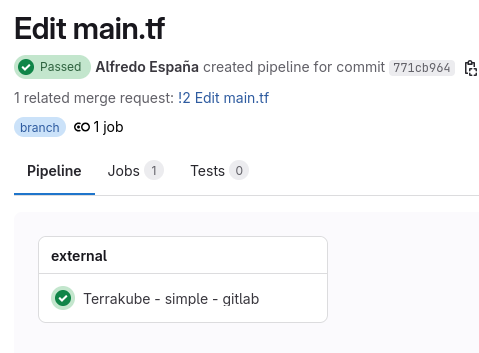
After every job execution a status will be shown inside gitlab
#### Bitbucket Integration
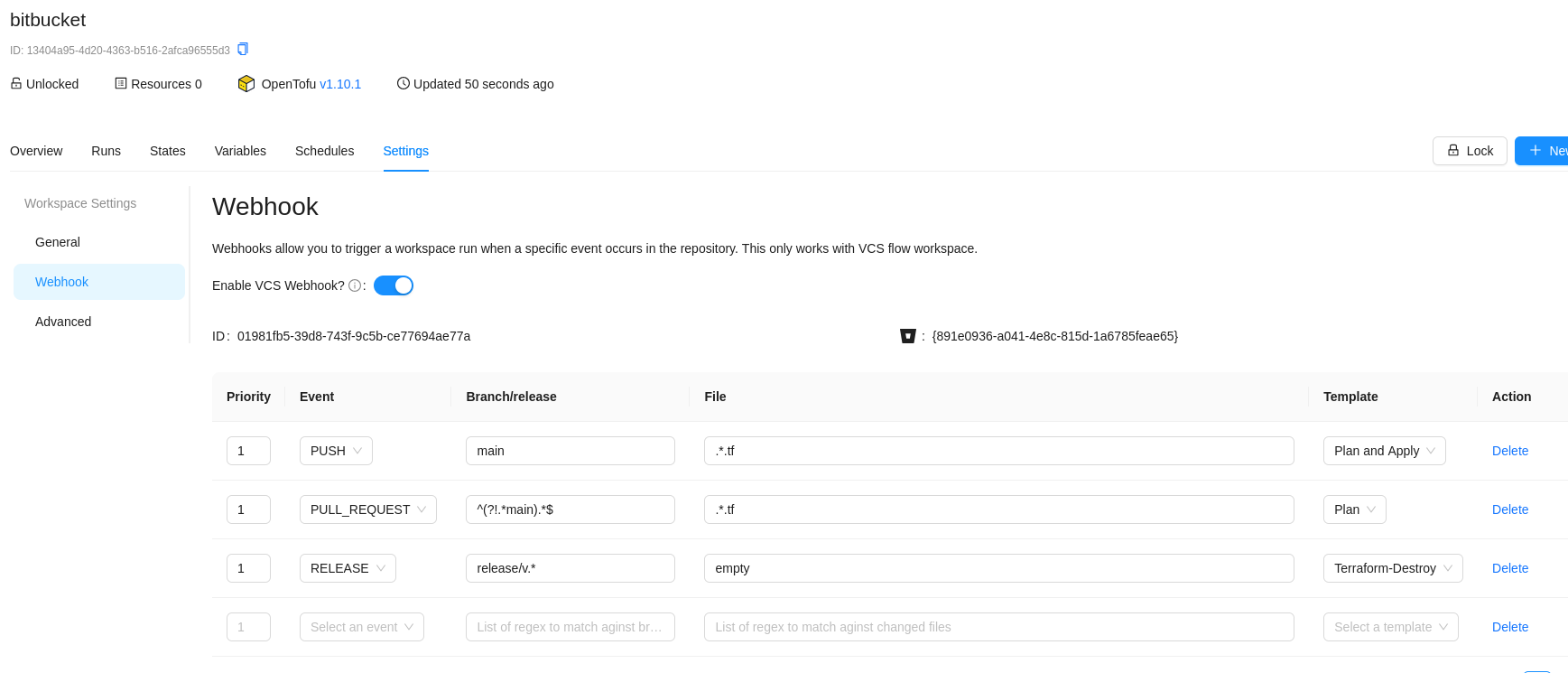
Support has been added for triggering jobs through `pull request` and `release` events in Bitbucket.
#### Improved Development Environment Support
The `devcontainer` environment now offers enhanced support for both PostgreSQL and MSSQL databases, facilitating more flexible development workflows.
#### Internal System Migration
The entire project codebase has been migrated to the `io.terrakube` package structure. Concurrently, all previously defined Quartz jobs have been successfully migrated to this new package hierarchy, ensuring consistency and maintainability.
Older releases (2.11 to 2.22) are in the [archive](/2.34.0/updates/updates-archive.md).
---
# Agent Instructions
This documentation is published with GitBook. GitBook is the documentation platform designed so that both humans and AI agents can read, navigate, and reason over technical content effectively. Learn more at gitbook.com.
## Querying This Documentation
If you need additional information that is not directly available in this page, you can query the documentation by asking a question.
Perform an HTTP GET request on the following URL with the `ask` and `goal` query parameters:
```
GET https://docs.terrakube.io/2.34.0/updates.md?ask=&goal=
```
`ask` is the immediate question: it should be specific, self-contained, and written in natural language.
`goal` is what the user is ultimately trying to achieve, the reason they need the answer. Sharing it helps GitBook give you a better, more relevant answer. A goal is most helpful when it describes the outcome the user wants rather than restating the question. For example, with `ask=how do I create an API token`, a goal like `automate deployments from our CI pipeline` lets GitBook tailor the answer to that use case.
The response will contain a direct answer to the question and relevant excerpts and sources from the documentation.
Use this mechanism when the answer is not explicitly present in the current page, you need clarification or additional context, or you want to retrieve related documentation sections.